What to make a knife

Materials for the handle – a never ending story.

There are a lot of materials that we can use to make the handle. I will try to briefly describe the most frequently used ones. These materials can be divided into the following categories: natural, synthetic and hybrids, which are a combination of both.

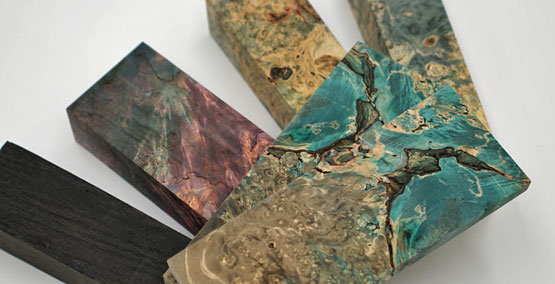
The solution to this is a process called stabilization. The dried piece of wood is placed in an epoxy resin container. Then the whole is placed in a vacuum chamber for several hours for resin to penetrate the wood completely.  The last stage is hardening the resin in the oven at a temperature of about 200°Celsius. The piece of wood prepared in this way becomes a hybrid between a natural and an artificial material. It looks like an ordinary piece of wood, but becomes more resistant to weather conditions and it is easier to process mechanically or manually. The same process is used to stabilize  objects like: cones, mammoth bones and other materials of natural origin. An objective disadvantage of this solution is its price, which compared to ordinary wood, is several times higher. For stabilization you can use dyes of various colors, which are mixed with epoxy resins. This, in combination with the burls of various tree species, gives beautiful, unpredictable and unique effects.

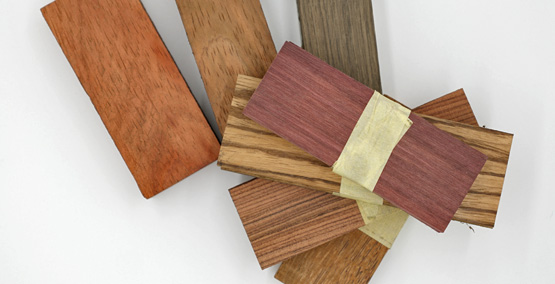
The most popular choice that comes to mind is wood. However, as straightforward as it may seem, it is not, largely due to the natural wood wrapping process. In my experience, even well-dried exotic woods (which are more oily and structurally denser than our native wood species), bought in a knifemaker shop, shrinks slightly a while after gluing and profiling the handle. Leaving a noticeable difference in height between the scales and the pins and the tang. This is due to the level of air humidity. Dry air causes the wood to shrink.

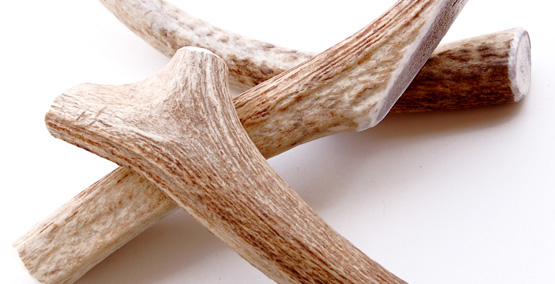
In addition to wood, the most common natural material that is used for the entirety of the handles or inserts combined with wood are antlers and animal bones. This very interesting material, due to its unique texture, gives off a specific smell during machining (drilling and grinding). In the case of the antlers, the most problematic is the “sponge” inside.  It can be superficially hardened with cyanoacrylate glue or the sponge can be removed with a drill for example. The formed hole can be filled with epoxy resin.  Stabilised mammoth teeth and tusks are often used as a small parts of the knife handles.

Synthetic materials are also frequently used in knifemaking. In my view, these are the most popular ones:

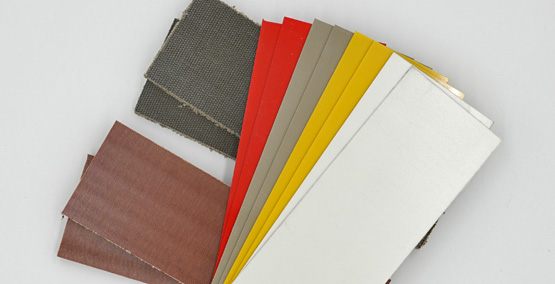
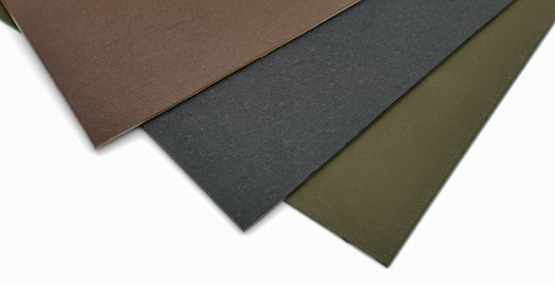
  • Micarta –  Is a laminate generally made of sheets of various materials laid in layers (created by stacking multiple layers) and filtered with epoxy resin. The most common micarta is produced in USA Canvas Micarta, available in black, brown and olive green colour. Of course, you can make a micarta yourself using denim, uniforms or even newspapers. In this case we are only limited by our imagination.
  • G10 – Is also an epoxy resin laminate, however in this case, the other component used to manufacture it is fiberglass. G10 is a material very resistant to mechanical damage. It is completely resistant to water absorption and has a good resistance to high temperatures. It is available in various thicknesses, for example thin sheets (1-2mm) are used as decorative spacers between the knife’s tang and the scales. They can also be used to separate different materials from which the handle is made. Thicker sheets (6-8mm) can be used as scales. G10 is also  available in the form of blocks, which can be used to build the handles of hidden-tang knives. This material is available in many colors.
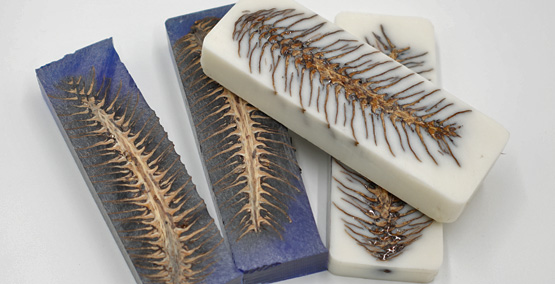
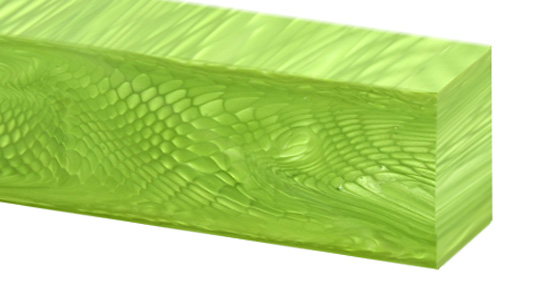
  • Juma – Is another resin-based material. It is the best choice if we want your knife handle to have an interesting texture, such as snake’s scales or carbon fiber. Juma is very easy to cut, it is very hard, it does not absorb water and it is resistant to oils, greases, bases and weak acids. An additional advantage of this material is thermoformability in boiling water. Undoubtedly, juma is a very interesting material considering its visual aspects. The downside is its price, as the cost of a 50x50x150mm block is about PLN 200.

As I mentioned at the beginning, there are a lot of other materials that can be used to make a knife handle: Raffir blocks, Dymondwood scales or carbon fiber. Of course, all these materials, as well as non-ferrous metals such as bronze, alpaca, brass, copper or stainless steel, can be freely combined with each other.  For example, we can make a hidden-tang knife handle from a combination of stabilized wood, alpaca spacers, mammoth tooth and bronze bolster. Anything is possible.

Bolsters, pins, tubes and other tinsels.

This subject involves mainly non-ferrous metals, but not exclusively. Other materials frequently used are carbon fiber, G10 or a combination of non-ferrous metals with colored resins in the form of mosaic and picture pins.

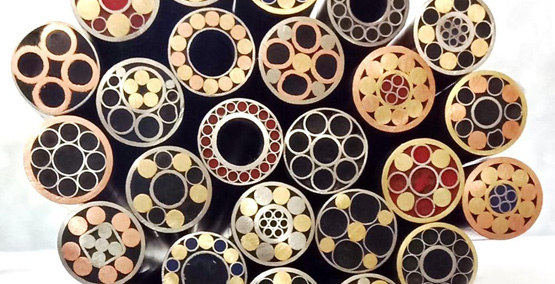
Earlier, I mentioned mosaic pins, which are nothing more than a small mosaic made of metal pipes and shafts of different diameters. For instance, brass pipes can be inserted into each other and filled with epoxy resin, often with contrasting color. More complicated picture pins are also available. A great example of such pins are the works of Alexey Balatsky. Such pins will easily help us personalize the handle of our knife.

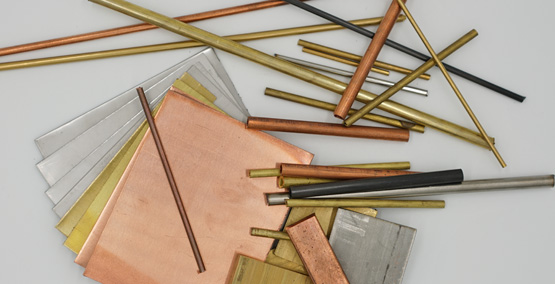
Flat bars, sheets, shafts and tubes. These all are the forms in which non-ferrous alloys and stainless steel are used to make knife “jewellery”. The forms worth distinguishing here are: copper, brass, alpaca and bronze. All these metals develop a patina over time, mainly due to the contact with sweat from our hands. For some, this is a desirable phenomenon, as it gives the metal the effect of aging. All these alloys can also be easily blackened with chemicals. Out of all these metals, stainless steel is the most resistant material to taking on additional visual effects but it is also the most resistant to grinding.

Lanyard.

It is a type of pendant threaded through a tube, usually located at the end of the knife handle. It makes it easier for us to pull the knife out of the sheath. Longer lanyards protect against the knife potentially falling out of the hand during tasks such as chopping.

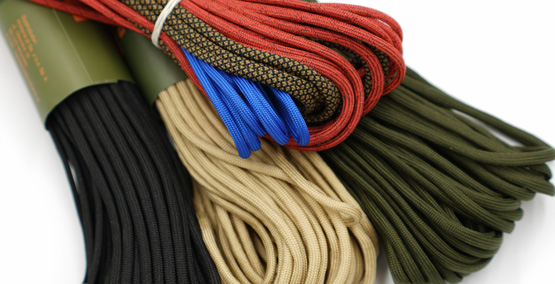
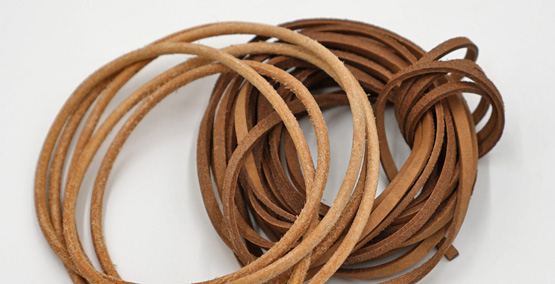
Lanyards are most frequently made of Paracord – a durable parachute line available in many patterns and colors. They can also be made of a leather thong that can be dyed, for example, to match the colour of the stealth.

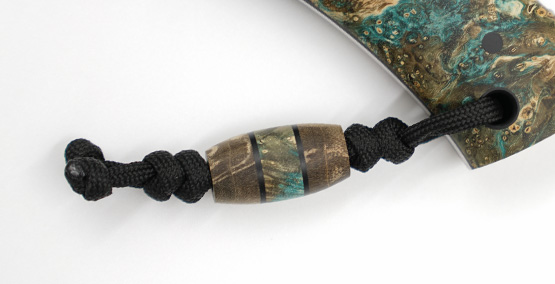
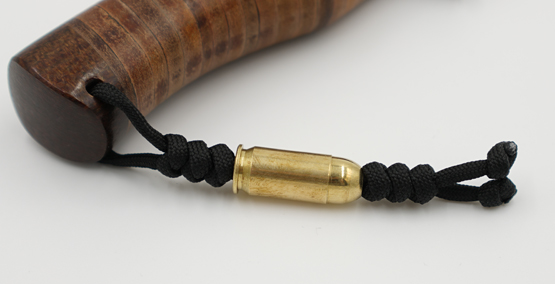
An inseparable part of the lanyard is a bead, which is usually made of the same materials as a handle, but can also be made of a pistol cartridge or from ready-made beads that we can buy.

Sheath materials.

The most frequently material natural leather, but not exclusively. Today’s technology enables us to create synthetic materials in the comfort of our own home.

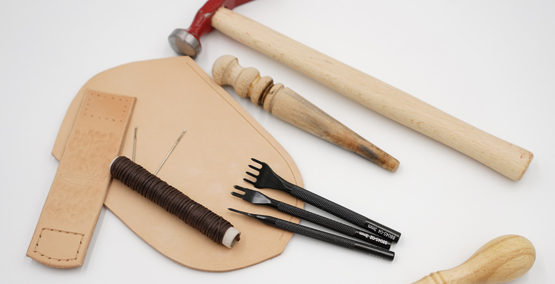
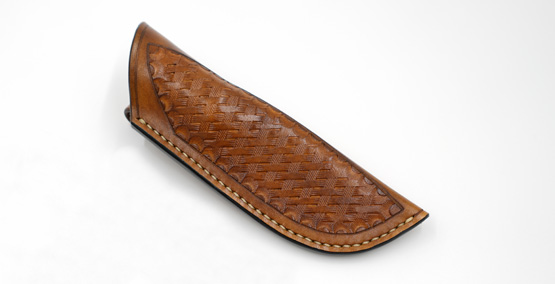
Natural leather – it is a timeless material known in craftsmanship for centuries. In my work,  I use vegetable tanned cowhide. Although it comes in various thicknesses, the best for sheaths is the 3.0 – 3.5mm option. Leather can be embossed with various patterns, dyed with water or spirit-based dyes. It can also be combined with exotic skins or furs. These individual elements are sewn together with waxed threads. Wet leather can be easily formed so that it adapts to the knife’s shape. 

Natural leather is definitely a more elegant material than, for example, Kydex. However, its resistance to weather conditions is lower, in particular to moisture and mechanical damage. The waterproof properties of leather can be improved with various types of leather preparations.

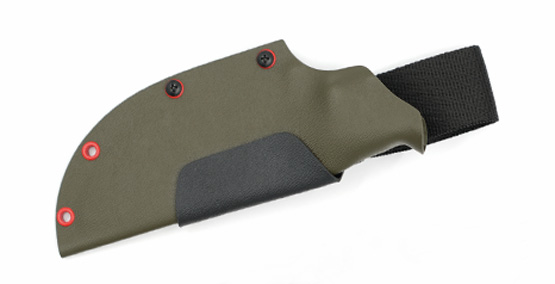
Kydex, Holstex and Boltaron – all these materials are very similar to each other and they differ mainly in texture. Kydex is predominantly available in solid colors, although it can also be acquired in camouflages and other graphics. It is matte and has a rough texture. Holstex, on the other hand, has a texture resembling carbon fiber.

All these materials are thermoplastics. This means that when heated to a temperature of about 150°Celsius, they become soft. In practice, a knife is put in between two heated pieces of kydex which are then placed in a special press which, after squeezing, will give the future sheath the shape of a knife. After this process, the formed Kydex is cut to size and fastened with metal eyelets, which are available in various colors. The last step is attaching a belt sling in the form of Tek-locks or polypropylene tapes to the sheath prepared in this way.

The great advantage of these materials is resistance to chemicals and mechanical damage. The downside is the lack of resistance to high temperatures. A sheath left in the vicinity of factors such as fire will certainly deform.

All these materials are available in different thicknesses, which has an impact on the accuracy and number of details that will be imprinted from the knife during forming. Needless to say, thinner sheets will convey more detail.

Above, I have described the most popular materials used in knifemaking. Of course, there are many more to choose from, but my objective was to focus on the materials that I use most frequently in my work and that I have experience processing. However, as mentioned before, there are many other options available and the final material selection is always down to our idea for a knife. It is just worth considering that certain materials’ unique properties make them more suitable for knifemaking.

The purpose of this article is to outline some basics to people who have never ordered a custom knife before. If you have any additional doubts or questions, please do not hesitate to contact me. I will be more than happy to explain everything.

Materials for the handle – a never ending story.

There are a lot of materials that we can use to make the handle. I will try to briefly describe the most frequently used ones. These materials can be divided into the following categories: natural, synthetic and hybrids, which are a combination of both.

The most popular choice that comes to mind is wood. However, as straightforward as it may seem, it is not, largely due to the natural wood wrapping process. In my experience, even well-dried exotic woods (which are more oily and structurally denser than our native wood species), bought in a knifemaker shop, shrinks slightly a while after gluing and profiling the handle. Leaving a noticeable difference in height between the scales and the pins and the tang. This is due to the level of air humidity. Dry air causes the wood to shrink.

The solution to this is a process called stabilization. The dried piece of wood is placed in an epoxy resin container. Then the whole is placed in a vacuum chamber for several hours for resin to penetrate the wood completely.  The last stage is hardening the resin in the oven at a temperature of about 200°Celsius. The piece of wood prepared in this way becomes a hybrid between a natural and an artificial material. It looks like an ordinary piece of wood, but becomes more resistant to weather conditions and it is easier to process mechanically or manually. The same process is used to stabilize  objects like: cones, mammoth bones and other materials of natural origin. An objective disadvantage of this solution is its price, which compared to ordinary wood, is several times higher. For stabilization you can use dyes of various colors, which are mixed with epoxy resins. This, in combination with the burls of various tree species, gives beautiful, unpredictable and unique effects.

In addition to wood, the most common natural material that is used for the entirety of the handles or inserts combined with wood are antlers and animal bones. This very interesting material, due to its unique texture, gives off a specific smell during machining (drilling and grinding). In the case of the antlers, the most problematic is the “sponge” inside.  It can be superficially hardened with cyanoacrylate glue or the sponge can be removed with a drill for example. The formed hole can be filled with epoxy resin.  Stabilised mammoth teeth and tusks are often used as a small parts of the knife handles.

Synthetic materials are also frequently used in knifemaking. In my view, these are the most popular ones:

  • Micarta –  Is a laminate generally made of sheets of various materials laid in layers (created by stacking multiple layers) and filtered with epoxy resin. The most common micarta is produced in USA Canvas Micarta, available in black, brown and olive green colour. Of course, you can make a micarta yourself using denim, uniforms or even newspapers. In this case we are only limited by our imagination.
  • G10 – Is also an epoxy resin laminate, however in this case, the other component used to manufacture it is fiberglass. G10 is a material very resistant to mechanical damage. It is completely resistant to water absorption and has a good resistance to high temperatures. It is available in various thicknesses, for example thin sheets (1-2mm) are used as decorative spacers between the knife’s tang and the scales. They can also be used to separate different materials from which the handle is made. Thicker sheets (6-8mm) can be used as scales. G10 is also  available in the form of blocks, which can be used to build the handles of hidden-tang knives. This material is available in many colors.
  • Juma – Is another resin-based material. It is the best choice if we want your knife handle to have an interesting texture, such as snake’s scales or carbon fiber. Juma is very easy to cut, it is very hard, it does not absorb water and it is resistant to oils, greases, bases and weak acids. An additional advantage of this material is thermoformability in boiling water. Undoubtedly, juma is a very interesting material considering its visual aspects. The downside is its price, as the cost of a 50x50x150mm block is about PLN 200.

As I mentioned at the beginning, there are a lot of other materials that can be used to make a knife handle: Raffir blocks, Dymondwood scales or carbon fiber. Of course, all these materials, as well as non-ferrous metals such as bronze, alpaca, brass, copper or stainless steel, can be freely combined with each other.  For example, we can make a hidden-tang knife handle from a combination of stabilized wood, alpaca spacers, mammoth tooth and bronze bolster. Anything is possible.

Bolsters, pins, tubes and other tinsels.

This subject involves mainly non-ferrous metals, but not exclusively. Other materials frequently used are carbon fiber, G10 or a combination of non-ferrous metals with colored resins in the form of mosaic and picture pins.

Flat bars, sheets, shafts and tubes. These all are the forms in which non-ferrous alloys and stainless steel are used to make knife “jewellery”. The forms worth distinguishing here are: copper, brass, alpaca and bronze. All these metals develop a patina over time, mainly due to the contact with sweat from our hands. For some, this is a desirable phenomenon, as it gives the metal the effect of aging. All these alloys can also be easily blackened with chemicals. Out of all these metals, stainless steel is the most resistant material to taking on additional visual effects but it is also the most resistant to grinding.

Earlier, I mentioned mosaic pins, which are nothing more than a small mosaic made of metal pipes and shafts of different diameters. For instance, brass pipes can be inserted into each other and filled with epoxy resin, often with contrasting color. More complicated picture pins are also available. A great example of such pins are the works of Alexey Balatsky. Such pins will easily help us personalize the handle of our knife.

Lanyard.

It is a type of pendant threaded through a tube, usually located at the end of the knife handle. It makes it easier for us to pull the knife out of the sheath. Longer lanyards protect against the knife potentially falling out of the hand during tasks such as chopping.

Lanyards are most frequently made of Paracord – a durable parachute line available in many patterns and colors. They can also be made of a leather thong that can be dyed, for example, to match the colour of the stealth.

An inseparable part of the lanyard is a bead, which is usually made of the same materials as a handle, but can also be made of a pistol cartridge or from ready-made beads that we can buy.

Sheath materials.

The most frequently material natural leather, but not exclusively. Today’s technology enables us to create synthetic materials in the comfort of our own home.

Kydex, Holstex and Boltaron – all these materials are very similar to each other and they differ mainly in texture. Kydex is predominantly available in solid colors, although it can also be acquired in camouflages and other graphics. It is matte and has a rough texture. Holstex, on the other hand, has a texture resembling carbon fiber.

All these materials are thermoplastics. This means that when heated to a temperature of about 150°Celsius, they become soft. In practice, a knife is put in between two heated pieces of kydex which are then placed in a special press which, after squeezing, will give the future sheath the shape of a knife. After this process, the formed Kydex is cut to size and fastened with metal eyelets, which are available in various colors. The last step is attaching a belt sling in the form of Tek-locks or polypropylene tapes to the sheath prepared in this way.

The great advantage of these materials is resistance to chemicals and mechanical damage. The downside is the lack of resistance to high temperatures. A sheath left in the vicinity of factors such as fire will certainly deform.

All these materials are available in different thicknesses, which has an impact on the accuracy and number of details that will be imprinted from the knife during forming. Needless to say, thinner sheets will convey more detail.

Natural leather – it is a timeless material known in craftsmanship for centuries. In my work,  I use vegetable tanned cowhide. Although it comes in various thicknesses, the best for sheaths is the 3.0 – 3.5mm option. Leather can be embossed with various patterns, dyed with water or spirit-based dyes. It can also be combined with exotic skins or furs. These individual elements are sewn together with waxed threads. Wet leather can be easily formed so that it adapts to the knife’s shape. 

Natural leather is definitely a more elegant material than, for example, Kydex. However, its resistance to weather conditions is lower, in particular to moisture and mechanical damage. The waterproof properties of leather can be improved with various types of leather preparations.

Above, I have described the most popular materials used in knifemaking. Of course, there are many more to choose from, but my objective was to focus on the materials that I use most frequently in my work and that I have experience processing. However, as mentioned before, there are many other options available and the final material selection is always down to our idea for a knife. It is just worth considering that certain materials’ unique properties make them more suitable for knifemaking.

The purpose of this article is to outline some basics to people who have never ordered a custom knife before. If you have any additional doubts or questions, please do not hesitate to contact me. I will be more than happy to explain everything.